Gutters Overflowing at the Corners in Heavy Rain? Why the Downspout Sizing Is Off
You're standing under the eave during a real downpour, the kind that shows up two or three times a season, watching a curtain of water peel off the gutter right at the corner. The straight runs on either side look fine. It's just that one seam, that one turn, where the water gives up on the trough entirely and free-falls onto the walkway or the flower bed below. You cleaned the gutters last fall. Not leaves, then. Not a sag either, since the corner sits level with the rest of the run. What you're looking at is almost always a sizing problem, and the corner is just where an undersized system shows its hand first.
Quick Answer: Gutters overflow at corners in heavy rain because two roof planes (or a roof valley) dump their combined runoff into that single point, and if the downspout serving that section wasn't sized for the actual roof area feeding it, the trough fills faster than the outlet can drain it. The fix isn't a bigger gutter in most cases. It's matching downspout capacity, placement, and count to the square footage each outlet actually handles.
The Corner Isn't the Problem, It's the Evidence
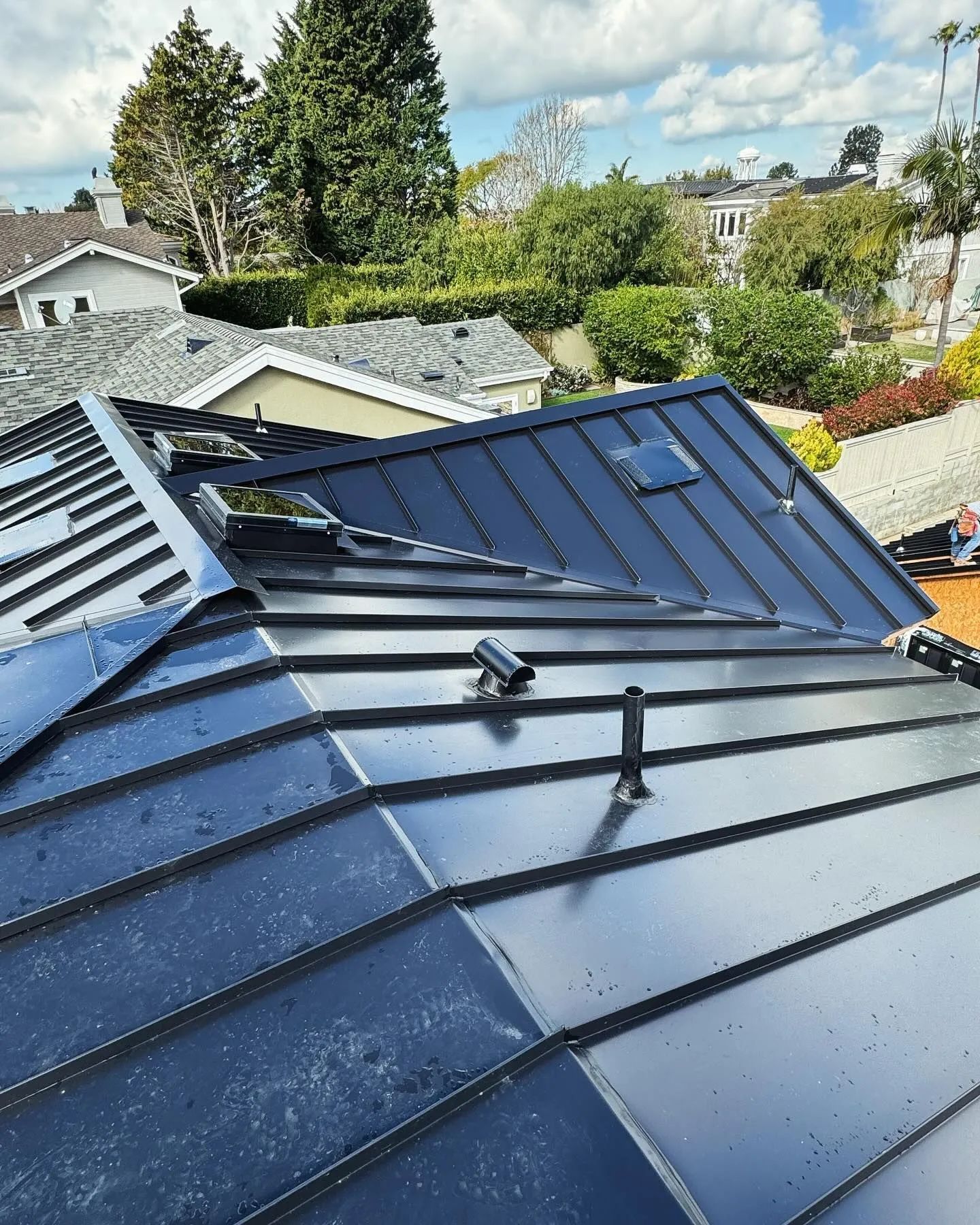
A straight stretch of gutter only has to manage water falling directly above it. A corner has to manage that, plus whatever's arriving from the adjoining roof plane, plus the concentrated stream a nearby valley dumps into it. Two roof faces meeting at an inside corner roughly double the runoff hitting that short section of trough compared to a straight run of the same length. When a roof valley empties near that same corner, the water isn't spread across the gutter anymore. It arrives as a fast, narrow stream aimed at one spot, hitting the trough with enough force to jump the front lip before it even reaches the downspout.
None of that would matter much if the downspout draining that section could keep pace. Most of the time, it can't. Downspouts get sized once, during the original install, off a rough guess or whatever standard size the crew had on the truck that day, not off a real calculation of how much roof actually drains to that spot. And corners are where that shortcut gets exposed first, because they carry more water than any other stretch of the run.
How Downspout Sizing Is Actually Supposed to Work
Downspout capacity comes down to cross-sectional area matched against drainage area, which is the total roof square footage that sheds water into a given gutter section. A widely used rule of thumb, drawn from residential sizing guides, puts it at roughly one square inch of downspout opening for every 100 square feet of roof area feeding it. That's a starting point, not an exact science, but it's a useful gut check.
Round downspouts
A 3-inch round downspout handles somewhere around 700 square feet of drainage area. Step up to 4-inch round and that jumps to roughly 1,250 square feet.
Rectangular downspouts
A 2-by-3-inch rectangular downspout is rated for around 600 square feet. A 3-by-4-inch downspout roughly doubles that, up to about 1,200 square feet.
Spacing along the run
Downspouts generally need to sit no more than about 35 to 40 feet apart on longer gutter runs, and on shorter or more complex rooflines, an outlet roughly every 20 feet is a common target. A run with one downspout doing the work of two, or an outlet planted at the wrong end of a section, forces water to travel further inside the trough before it drains, which is exactly the kind of delay that shows up as overflow at whichever point sees the heaviest flow.
Plumbing codes take this further by tying pipe size to rainfall rate rather than a flat rule of thumb. Sizing tables built off the Uniform Plumbing Code, for instance, size a 3-inch downspout for anywhere from roughly 1,300 to 6,400 square feet of roof area depending on the design rainfall rate used, with the lower end of that range reflecting the more intense storm rates. That spread matters, because a downspout sized comfortably for a light, steady rain can be badly undersized the moment a storm cell dumps rain faster than the design assumed.
Tip:
Walk your roofline and count how many downspouts actually drain each gutter run, then estimate the square footage of roof feeding each one. If a single 2x3 downspout is draining more than roughly 600 square feet of roof, or a single 3-inch round is draining much past 700, that's a sizing gap worth having looked at, corner overflow or not.
Why the Symptom Shows Up Specifically at Corners
Water inside a gutter run doesn't move in a straight, even sheet. At an inside miter, where two gutter sections meet at an angle, the flow from both directions collides and has to change direction to keep moving toward the downspout. That collision slows the water down and piles it up right at the seam, which is precisely why a corner overflows before a straight section does even when both are carrying water from the same storm.
Add a roof valley discharging into or near that same corner and the effect compounds. A valley concentrates runoff from two full roof planes into a stream that's often moving faster and carrying more volume than diffuse sheet flow off a plain roof edge. Without something to catch and redirect that stream, either a diverter plate or a gutter and downspout combination sized for the extra load, the water simply outruns the trough's capacity to hold it before the corner turn slows it further.
This is also why corner overflow tends to show up during the heaviest bursts of a storm rather than during a light, steady rain. A drizzle spreads evenly and gives the downspout time to keep up. A hard, fast cell overwhelms the weakest link in the system almost immediately, and the weakest link is usually the corner carrying the most combined runoff through the smallest bottleneck.
When It's Worth Having a Professional Look at the Sizing
A single overflowing corner during an unusually hard storm isn't automatically a red flag. But a few patterns are worth paying attention to. If the same corner overflows every time it rains hard, regardless of how recently the gutters were cleaned, that's a sizing issue rather than a debris issue. If you're seeing water marks, staining, or soft spots on the fascia board directly below a corner, the overflow has been happening long enough to start affecting the wood it's supposed to be protecting. And if a remodel or roof replacement changed the roofline since the gutters were installed, the original downspout sizing may no longer match the roof area it's now draining.
Warning: Don't attempt to walk a wet or recently rained-on metal roof yourself to inspect for loose fasteners or lifted seams. Wet metal is a lot more slippery than it looks, roof pitches in hillside neighborhoods are often steeper than they appear from the ground, and a fall from roof height is a serious injury risk. Leave hands-on inspection of the roof surface to someone with the right footwear, harness, and experience working on metal.
A proper assessment starts with mapping the actual drainage area feeding each downspout, not just eyeballing the roofline. That means accounting for every roof plane that sheds toward a given gutter section, any valleys that concentrate flow into a specific point, and the true square footage each outlet is responsible for, then comparing that against the downspout's rated capacity. Where a corner is taking on more than its outlet can move, the fix might be upsizing that specific downspout, adding a second outlet closer to the valley discharge point, or installing a diverter that breaks up the concentrated stream before it hits the trough. Sometimes it's a combination of two of those, since a bigger downspout doesn't help much if the water is still overshooting the gutter before it ever reaches the outlet.
What a Proper Fix Actually Involves
Getting this right isn't a matter of swapping in a larger downspout and hoping for the best. It starts with walking the roofline and identifying every plane, ridge, and valley that contributes runoff to each gutter section, since a corner fed by two full roof faces and a valley needs a completely different capacity than a corner fed by a single small roof plane. From there, the drainage area for each section gets measured against downspout capacity using the same sizing logic outlined above, cross-sectional area matched to square footage, with enough margin built in for the kind of hard, fast bursts Southern California storms are known for rather than just average rainfall.
Where a corner is badly overloaded, the correction usually involves some mix of a larger outlet, an additional downspout positioned closer to the point of highest flow, and in valley-fed sections, a diverter or apron flashing that catches the concentrated stream and redirects it into the trough instead of letting it sail past the corner. Custom-fabricated downspouts and outlets also make it possible to fit the right size into tight architectural spots, like a corner boxed in by a covered patio or a narrow side yard, where a standard off-the-shelf size might not physically fit even if the capacity math says it should.
The goal isn't just stopping the overflow you can see. It's making sure the whole system, gutter capacity, downspout sizing, spacing, and outlet placement, is matched to how water actually moves across your specific roof, so the next hard storm finds a system with margin instead of one running right at its limit.
Flashing at Chimneys, Skylights, and Walls
The second most common leak zone is anywhere metal roofing meets something that isn't more roofing. Chimneys, skylights, dormers, and the point where a roof plane meets a vertical wall all require flashing, which is a separate piece of formed metal that bridges the gap and directs water away from the seam instead of into it.
Flashing takes a beating over the years. The caulking or sealant used to finish the edges dries out under UV exposure and starts to crack, usually well before the metal itself shows any wear. Once that seal fails, wind-driven rain can work its way behind the flashing lip during a storm, especially at chimneys where the masonry and metal expand at different rates and slowly pull the flashing loose at the corners.
If your ceiling stain is directly below a chimney, near a skylight, or along an interior wall that backs up to the roofline, flashing is the first place to suspect. This is also one of the more common repair calls after a rare heavy rain, because a flashing seal that held fine through years of light drizzle can finally give out under sustained, driving water.
Tip:
When you spot a stain, look straight up through the attic if you can access it safely. Water often travels along a rafter or sheathing seam before it drips through the ceiling below, so the wet spot on the drywall isn't always directly under the actual leak point on the roof. Tracing the path in the attic first can save you from chasing the wrong section of roof entirely.
Frequently Asked Questions
Is a corner overflowing always a downspout sizing problem?
Not always. Clogged outlets, sagging sections, and poor pitch cause corner overflow too. The tell for a sizing issue is overflow that repeats during hard rain even right after cleaning and a sag check.
Would a bigger gutter fix this without touching the downspouts?
Sometimes it helps, since a wider trough holds more water. But if the downspout still can't move water out fast enough, a bigger gutter only delays the overflow rather than actually solving it.
Why does this happen more during specific storms and not every time it rains?
Light rain gives a marginal downspout time to keep pace. A hard, fast burst delivers more water than the outlet can move, which is when an undersized downspout finally shows itself.
Can adding a second downspout near the corner solve the problem on its own?
Often yes in valley-fed or double-plane corners, since two outlets split the drainage load. It works best paired with a check on whether a diverter is needed to slow the concentrated stream.
Does roof material affect how much water a gutter and downspout need to handle?
Roof material affects runoff speed more than volume. Smooth, hard surfaces shed water faster than textured ones, pushing more water into the gutter quickly and straining a downspout already sized near its limit.
How do I know if my current downspouts match my roof's drainage area?
Compare each downspout's cross-sectional size against the roof square footage draining into it, using the 1-inch-per-100-square-feet guideline. For anything near the line, a proper drainage assessment beats the rule of thumb.
Reading the Corner Before the Next Storm
The corner that gives up on the trough is rarely the villain in this story. It's the messenger, showing you where an undersized outlet has been quietly falling behind all along. Once you understand that the water arriving there carries the combined load of two roof planes and often a valley, the pattern stops looking random. Heavy bursts expose the weakest link first, and that link tends to sit exactly where the most runoff meets the smallest bottleneck.
Matching downspout capacity, count, and placement to the real drainage area feeding each section is what separates a system with margin from one running at its limit. That kind of assessment rewards a careful eye and years of seeing how water moves across a specific roofline. Socal Sheet Metal, Inc., based in Canoga Park, CA, has spent 10
years fitting
outlets
and diverters to the way each roof sheds, so a hard storm meets capacity waiting instead of an overwhelmed corner.